
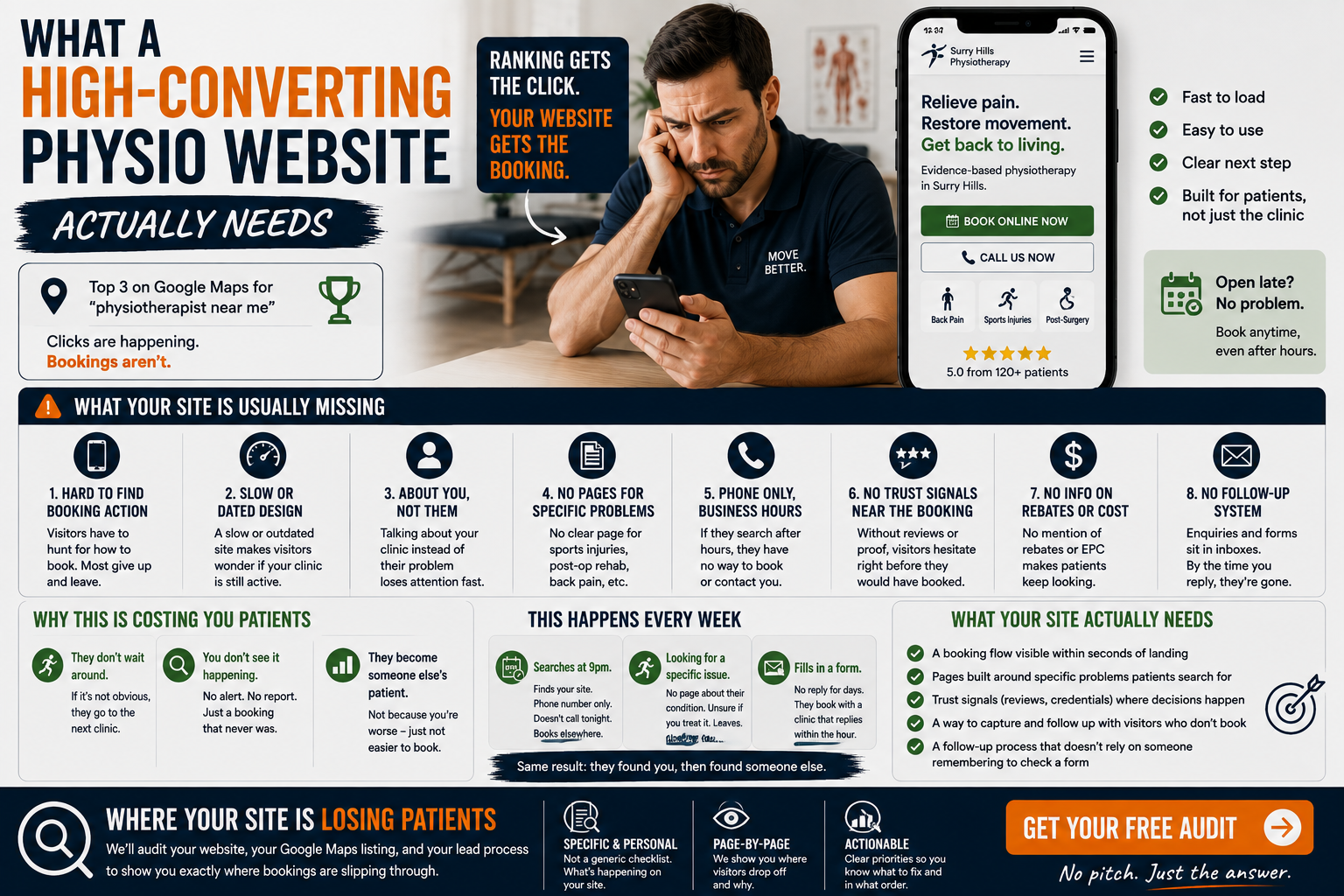
A physio clinic in Surry Hills ranks in the top 3 on Google Maps for "physiotherapist near me." The listing gets clicked most days. Bookings for the month barely move.
The Traffic Is There. The Bookings Aren't.
Most clinics get stuck right here. You've already done the hard part — you're visible, you rank, and people searching for physio nearby are finding you and clicking through.
The problem starts after the click. A visitor lands on your homepage, looks around for a few seconds, and leaves. No call. No booking. No sign of what they were looking for or why they left.
This isn't a traffic problem. Traffic is arriving on schedule. What happens in the next few seconds on the page decides whether that visit turns into a patient on your table next week.
You probably never check that part. You check your Maps ranking, see you're sitting in the top 3, and assume the marketing is working. Ranking measures whether people can find you. It says nothing about whether they book.
What Your Site Is Usually Missing
From the outside, your site looks fine. The Maps listing is active, the reviews are solid, the website loads without issue. Underneath that, a few gaps are quietly turning interested visitors away before they ever pick up the phone:
- No booking button visible without scrolling, so visitors have to hunt for a way to act
- A slow, dated design that makes visitors wonder if the clinic is still active
- Homepage written about the clinic and the team, not the patient's problem — back pain, sports injury, post-surgery rehab
- No dedicated page for specific treatments, so a search for "sports physio" or "post-op rehab" can't tell if you treat it
- A phone number as the only way to reach you, with nothing for the person browsing after hours
- No reviews or trust signals anywhere near the booking action, so an interested visitor hesitates instead of committing
- No mention of health fund rebates or EPC referrals, so patients weighing the cost don't get an easy answer
- No system for following up with people who ask a question or fill in a form but don't book straight away
None of this shows up on a Google Maps profile. It only shows up in your booking calendar, as patients who never appeared.
Why This Is Costing You Patients
Every one of these gaps loses you someone who already wanted to book.
They don't leave because a competitor is better. They leave because the competitor's website made the next step obvious, and yours didn't.
This kind of patient doesn't complain. They don't leave a bad review or send you a message about it. They close the tab and call the next clinic on the list.
You don't see this happening in real time. There's no alert for a booking that never happened. Multiply it across a month and it's not one missed patient — it's a steady, invisible leak that never shows up next to your ranking or your visitor count.
This Happens Every Week
A patient with a sore shoulder finds your clinic on Google at 9pm. There's a phone number on the page and nothing else. They're not calling tonight, and they won't remember to tomorrow. They move to the next listing.
Someone searches "sports physio Parramatta" and lands on your homepage. It talks about your clinic's history and your team's qualifications. Nothing tells them you treat sports injuries specifically. They leave unsure whether you're the right fit and don't come back to check.
A patient fills in your contact form after a car accident, asking whether you handle CTP claims. No one replies for two days. By the time someone gets to it, she's already booked with a clinic that answered within the hour.
None of these patients were lost to price. They were lost to a website that gave them nothing to act on. Three different visitors, three different reasons, same result — they found the clinic, then found somewhere else to book.
What Your Site Actually Needs
Your site doesn't need a rebuild from scratch. It just needs a few things pointed in the right direction:
- A booking flow that's visible the moment someone lands on the page, so they never have to go looking for it
- Pages built around specific problems — sports injuries, post-surgery rehab, chronic pain — instead of one general services list
- Trust signals placed right where the decision happens, not buried on a separate page
- A way to capture patients who don't book immediately, so a missed enquiry isn't automatically a lost one
- A follow-up process that doesn't rely on someone remembering to check a contact form
Which of these apply to your site, and how badly, isn't something you can tell from your Maps ranking or your visitor count. It only shows up when someone checks the actual path a real patient takes from click to booking.
That's what an audit does.
If you want to know exactly where your website is losing patients, I'll audit it for free. You'll get a specific, page-by-page list of what's costing you bookings right now — not a generic checklist, but what's actually happening on your site. No pitch attached, just the answer.